


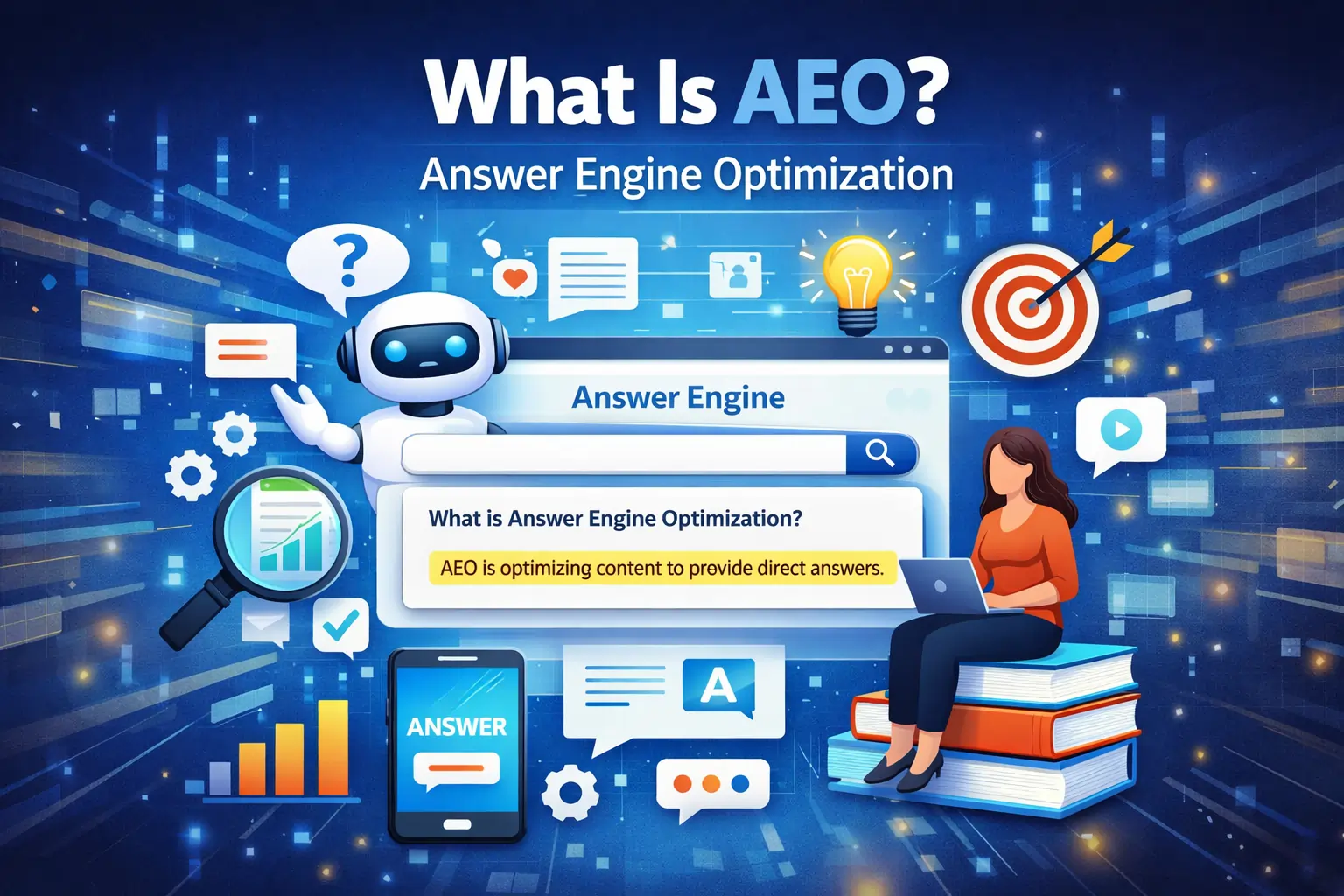
Answer Engine Optimization, or AEO, is the process of structuring content so AI systems can extract, understand, and present it as a direct answer. Instead of competing only for rankings, AEO focuses on becoming the answer itself within AI-driven search experiences. As platforms shift toward generated responses, businesses that align content with how AI retrieves and selects information are more likely to appear in those outputs. At Matheson Marketing, AEO is treated as a structural and entity-based approach to visibility, not just keyword targeting.
Answer Engine Optimization (AEO) is the practice of structuring website content so AI systems can directly extract and display it as an answer. It focuses on clarity, structure, and context rather than just keywords. Businesses using AEO are more likely to appear in AI-generated results like Google AI Overviews and conversational tools.
What Answer Engine Optimization Means Today
AEO reflects how search behavior has changed. Users are no longer scanning multiple links to find answers. They are receiving summarized responses directly from AI systems, often without clicking through to a website.
This changes the objective. Instead of ranking on a results page, content must be structured so it can be extracted, interpreted, and displayed accurately by AI engines. This includes clarity in how answers are written, how topics are organized, and how context is established across a page.
For service-based businesses operating in competitive areas like downtown Calgary, industrial parks, or multi-location service regions, this shift directly impacts visibility. Content must now function as a source of truth, not just a page competing for clicks.
AEO does not replace SEO. It builds on it by shifting the focus from ranking pages to becoming the source of answers within AI-generated results.
How AI Engines Extract Answers from Content
AI engines do not read content the way users do. They scan for structured, clearly defined information that can be isolated and reused as a direct response.
Direct Answer Formatting
Content that answers a question immediately and clearly is more likely to be selected. This typically involves placing a concise answer near the top of a section, followed by supporting detail.
Answers that are buried within long paragraphs or require interpretation are less likely to be extracted. Clear, self-contained responses improve the likelihood of selection.
This is especially critical for commercial service pages, where unclear answers can result in lost visibility even if the service is relevant.
Clear Headings and Semantic Flow
Headings act as signals that define what a section is about. AI systems rely on these to understand topic boundaries and relationships between ideas.
A logical flow between headings helps reinforce context. When sections build on each other without overlap or confusion, AI engines can map the content more accurately.
This becomes important when targeting multiple service variations, locations, or use cases across a site.
Contextual Relevance
AI does not evaluate content in isolation. It looks at how well the content aligns with the broader topic and whether supporting information reinforces the main answer.
This includes the presence of related concepts, consistent terminology, and clear connections between sections. Content that lacks context or introduces unrelated ideas is less likely to be selected.
In practice, this means covering not just the service itself, but when it applies, what it solves, and how it connects to related services.
Where AEO Appears
AEO applies anywhere AI systems generate answers instead of listing links. These environments vary, but they share the same requirement, content must be structured for extraction.
Google AI Overviews
Google’s AI Overviews generate summarized answers directly in search results. These responses pull from multiple sources and present a consolidated answer.
For businesses targeting high-intent searches, this is where visibility shifts from ranking to inclusion. If content is not structured properly, it is excluded regardless of authority.
ChatGPT and Conversational AI
Platforms like ChatGPT generate responses based on structured information and contextual understanding. They do not display ranked lists in the same way as traditional search engines.
Content that is easy to interpret and grounded in clear explanations is more likely to influence these outputs, even when the original source is not directly cited.
Voice Assistants
Voice assistants rely on concise, direct answers that can be delivered verbally. This limits the amount of information that can be used and increases the importance of clarity.
Content that answers questions in a single, well-structured response is more likely to be used in voice-based outputs.
Key Ranking Signals for AEO
AEO relies on signals that help AI determine whether content is trustworthy, understandable, and relevant to the query.
Authority and Brand Signals
AI systems assess whether a source demonstrates credibility within a topic. This includes brand consistency, topical focus, and how often the source is referenced across related content.
For businesses operating at scale across multiple service areas, consistent messaging and coverage across all services strengthens this signal.
Content Clarity and Structure
Clear writing and logical structure make it easier for AI to extract usable information. This includes concise sentences, defined sections, and answers that can stand on their own.
Content that requires interpretation or lacks clear boundaries between ideas is less likely to be selected. This is a common failure point on service pages that try to cover too much without clear separation.
Internal Linking Context
Internal links help establish relationships between topics. They signal how different pieces of content connect, which improves contextual understanding.
When links are placed naturally within relevant sections, they reinforce the authority of both the page and the broader site. Businesses looking to align their content with these principles often focus on structured optimization through services such as structured optimization.
AEO vs Traditional SEO
AEO and SEO serve different roles, even though they overlap in execution. SEO focuses on ranking pages, while AEO focuses on becoming the answer within AI-generated results.
| Factor | AEO | SEO |
|---|---|---|
| Primary Goal | Become the answer | Rank in search results |
| Output Format | AI-generated responses | Search result listings |
| Content Structure | Direct, extractable answers | Broad topic coverage |
| User Interaction | Often no click required | Click-based traffic |
| Optimization Focus | Clarity, structure, context | Keywords, backlinks, technical SEO |
 How to Structure Content for AEO
Structuring content for AEO requires aligning format, clarity, and context so AI systems can easily extract and reuse information.
- Start with a direct answer under each key heading
- Use clear, descriptive headings that match user queries
- Keep sections focused on a single idea or question
- Reinforce context with related concepts and consistent terminology
- Avoid burying answers inside long or complex paragraphs
- Use internal links to connect supporting content naturally
This structure supports both AI extraction and user clarity. It also improves inspection readiness, where content can be evaluated quickly for completeness and accuracy.
Mistakes That Prevent AI Visibility
Certain content patterns reduce the likelihood of being featured in AI-generated answers. These issues often relate to structure, clarity, or lack of context.
- Writing content without directly answering the query
- Using vague headings that do not match user intent
- Overloading sections with multiple ideas instead of one clear focus
- Relying only on keywords without establishing context
- Failing to connect related topics through internal linking
These issues often result in content being ignored by AI systems, even if it ranks in traditional search. Avoiding them ensures the page can function both as a ranking asset and as a source for AI-generated answers.