


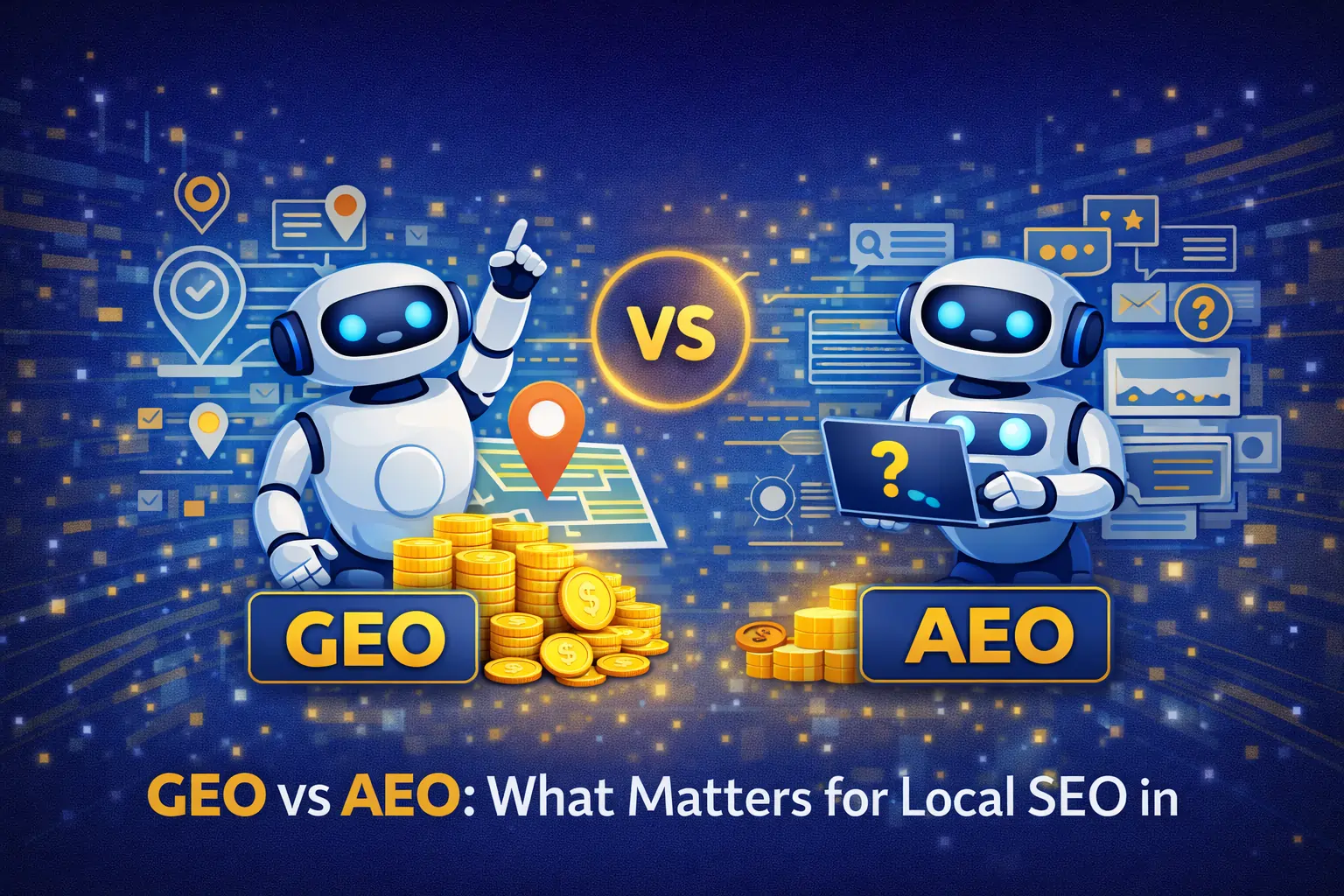
Search has shifted from ranking pages to generating answers. Local businesses are no longer competing only for positions on Google, they are competing to be selected, summarized, and presented inside AI-generated responses. As this shift accelerates, Matheson Marketing focuses on two systems that now define visibility, Generative Engine Optimization and Answer Engine Optimization. Understanding how they differ, and how they work together, determines whether a business appears in search or gets replaced by it.
Generative Engine Optimization (GEO) focuses on structuring your business, services, and locations so AI systems recognize you as a relevant local entity. Answer Engine Optimization (AEO) focuses on structuring your content so AI can extract and present it as a direct answer. GEO builds presence, AEO captures attention.
What GEO SEO Focuses On
GEO is built around how AI systems understand real-world businesses. It connects your services, locations, and authority into a structure that can be recognized across search environments.
Location Authority and Coverage
Local visibility depends on how clearly your business is tied to a geographic area. This goes beyond mentioning a city name. It includes demonstrating presence across real operating environments.
For example, businesses that show relevance across office buildings, industrial facilities, retail spaces, and multi-unit properties create stronger geographic signals than those using generic location references. This layered coverage helps AI understand where your business is relevant and where it should appear.
Service Area Mapping
GEO requires clear relationships between services and locations. Each service should be tied to defined service areas, not treated as a general offering.
This means creating structured coverage where each page reinforces both the service and its applicable environments. When done correctly, this builds a network of relevance that strengthens visibility across local searches.
Topical Clusters by Service Area
AI systems evaluate how deeply a topic is covered within a service area. A single page is not enough. Businesses need clusters of related content that reinforce expertise.
This includes service pages, supporting articles, and related topics that connect back to the core offering. Together, these form a topical map that increases authority.
What AEO Focuses On
AEO is focused on how content is written and structured so it can be extracted and used as an answer.
Answer Extraction
AI systems prioritize content that answers a question immediately and clearly. This means placing direct, concise responses at the start of sections, followed by supporting detail.
Content that requires interpretation or hides answers inside long paragraphs is less likely to be selected.
Content Clarity
Clarity determines whether AI can understand and trust your content. Each section should focus on a single idea, with clean separation between topics.
When content is structured logically, AI can identify what each section represents and how it connects to the overall topic.
AI Readability
AI readability is different from human readability. It requires content that is structured, consistent, and easy to break into usable segments.
This includes shorter sentences, defined sections, and answers that can stand on their own without additional context.
Where GEO and AEO Overlap
Although GEO and AEO serve different purposes, they rely on the same foundational signals.
Entity Signals
Both strategies depend on clearly defined entities, your business, your services, and your service areas.
When these are consistently reinforced across your site, AI systems can connect them and understand your relevance more accurately.
Structured Content
Structure is critical for both visibility and extraction. Clean headings, logical flow, and well-defined sections help AI process your content.
Without structure, even strong information becomes difficult to interpret.
Internal Linking
Internal links connect topics and reinforce relationships between pages. They show how services, service areas, and supporting content fit together.
When placed naturally within relevant sections, internal links strengthen both authority and contextual understanding. Businesses building this structure often rely on systems like structured SEO and AI visibility strategies to connect their content across multiple layers.
Key Differences That Impact Rankings
| Factor | GEO | AEO |
|---|---|---|
| Primary Goal | Establish local presence | Become the answer |
| Focus | Locations, services, authority | Clarity, structure, extractability |
| Output | Visibility across service areas | Inclusion in AI responses |
| Content Type | Service pages, topical clusters | Direct answers, structured content |
| User Interaction | Click-based discovery | Often no click required |
| Ranking Driver | Entity + service relevance | Answer quality + structure |
When GEO Alone Is Not Enough
GEO can establish visibility across service areas, but it does not guarantee selection within AI-generated results. A business may appear across multiple environments and still be excluded if its content is not structured for extraction.
In competitive industries, many businesses share similar coverage. Without clear answers, AI systems default to content that is easier to interpret.
When AEO Alone Falls Short
AEO can position content to be selected as an answer, but without strong entity and service area signals, that content may not be considered relevant.
This creates a gap where content performs well in general queries but lacks consistency in local visibility.
Real-World Example: How GEO and AEO Work Together
Consider a service-based business operating across multiple environments. The difference between GEO and AEO becomes clear when you break down how each strategy is applied.
A GEO-focused approach would include the following:
- Service pages tied to different service areas
- Coverage mapped to specific environments
- Supporting content reinforcing each area
This builds the foundation for visibility. However, visibility alone is not enough.
An AEO-focused approach would then layer in structure:
- Direct answers placed under key headings
- Clearly defined service use cases
- Content formatted so AI can extract and reuse it
When both are implemented together, the result is a system where the business is both recognized and selected within AI-driven search.
What Happens If You Ignore Both
Businesses that do not adapt to GEO or AEO risk losing visibility entirely, even if they previously ranked well. The impact becomes more noticeable as AI-generated results replace traditional listings.
Without GEO, the following issues appear:
- Weak service relevance
- Reduced presence in local results
- Competitors dominate coverage
Without AEO, the problem shifts toward content performance:
- Content is not selected by AI
- Visibility shifts to summarized competitor answers
- Organic traffic declines over time
These gaps compound over time, making it harder to recover lost visibility once competitors establish stronger structures.
How AI Evaluates GEO + AEO Together
AI systems evaluate both structure and context at the same time. Your content must meet multiple conditions simultaneously for it to be selected and displayed.
| Evaluation Layer | What AI Looks For | Impact |
|---|---|---|
| Service Relevance | Clear service-area mapping | Determines where you appear |
| Entity Clarity | Defined services and business identity | Builds trust |
| Content Structure | Clean headings and sections | Enables extraction |
| Contextual Depth | Supporting related topics | Strengthens authority |
| Internal Linking | Relationships between pages | Reinforces full-site understanding |
When to Prioritize Each Strategy
GEO should be prioritized when a business needs to establish or expand visibility across service areas. This is critical for companies operating in multiple environments, where coverage determines presence.
AEO should be prioritized when the goal is to capture high-intent queries and appear directly in AI-generated answers. This is especially important when users expect immediate, clear responses. Most businesses require both. GEO ensures you are recognized, while AEO ensures you are selected.
How to Combine GEO + AEO for Maximum Results
Combining both strategies requires a structured approach. It is not about choosing one over the other, but aligning them so they reinforce each other across your entire site.
A strong combined strategy typically includes the following elements:
- Build service pages that clearly define where and how you operate
- Structure each page with direct answers under key headings
- Create supporting content that reinforces each service across environments
- Use internal linking to connect services, service areas, and related topics
- Maintain consistent terminology to strengthen entity signals
- Keep content clear, structured, and easy for AI to extract
- Expand coverage across real operating environments, not just keywords
- Continuously refine content based on how AI surfaces results
When implemented consistently, this creates a system where visibility and selection work together rather than competing.