

Legacy voice search
Estimated read time: 8 minutes
BrightLocal research shows most consumers read reviews before choosing a local service provider.
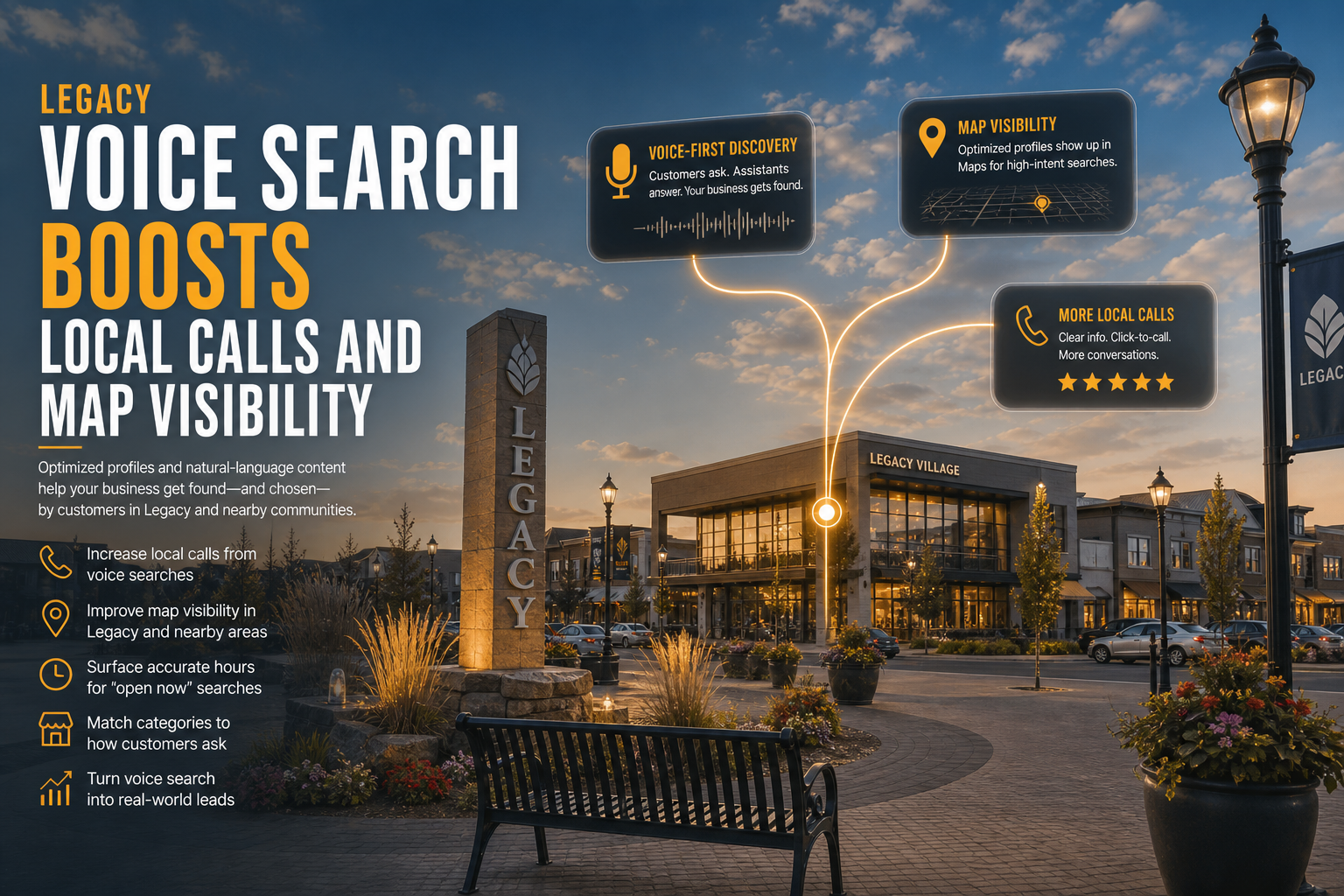
That makes Legacy Voice Search and AI-assisted local discovery heavily dependent on how well a business listing is built and maintained. For Legacy businesses, spoken queries like “open now near Legacy” are often answered from profile data before a website is ever visited.
Natural-language service pages, accurate hours, and tightly matched categories are not just cleanup tasks. They are discovery signals for customers moving between Township, Walden, and the Macleod Trail corridor. When those signals are aligned, businesses are more likely to earn calls, direction requests, and map visibility from high-intent searches. Matheson Marketing uses this structure to turn conversational search behavior into measurable local leads for Calgary neighbourhood businesses.
Legacy Voice Search Checklist
Use this checklist to improve Legacy Voice Search visibility for businesses serving Legacy, Township, and nearby southeast Calgary communities. The biggest gains usually come from tighter Google Business Profile setup, direct question-and-answer page copy, and review language that mentions both service and place.
| Metric | Target |
|---|---|
| Google Business Profile calls | 10%+ month-over-month growth |
| Direction requests from Legacy searches | 15%+ increase within 30 days |
| FAQPage schema indexed | 100% of implemented FAQ URLs indexed |
| Reviews mentioning Legacy or nearby communities | 25%+ of new reviews include a place reference |
- Rewrite the top service page intro and GBP Q&A into question-and-answer format using phrases like “open now near Legacy” and place the direct answer in the first sentence.
- Confirm the Google Business Profile category guidance primary category matches the highest-revenue service, then trim secondary categories to three to five entries that reflect actual work in Legacy, Walden, or Seton.
- Set service areas to Legacy first, then add only adjacent communities you genuinely serve, and align those entries with your booking system or dispatch radius.
- Update regular hours, holiday hours, and special hours in Google Business Profile, then verify the listing shows correctly for “open now” searches near Township Shopping Center and 210 Avenue SE.
- Request a review within 24 hours of each completed job and ask customers to mention the service type plus a location cue such as Legacy, Macleod Trail, or Seton.
When Legacy reviews mention the service but not the neighbourhood, tightening your Legacy review responses and local FAQ answers can give voice searches near Township Shopping Center and Macleod Trail SE clearer signals to match.
Why Spoken Queries Matter
Legacy Voice Search works best when business data matches how people actually speak on phones, in cars, and on map apps. In Legacy and nearby routes toward Walden, Silverado, and Macleod Trail SE, those searches often include urgency, distance, and opening hours in the same query.
How Legacy Residents Ask
In Legacy, residents near Township Shopping Center and along 210 Avenue SE often search by speaking complete questions, especially while driving toward Walden or Silverado. Spoken searches tend to include urgency, proximity, and service type, such as “who’s open now near Legacy.”
A practical step is to rewrite key service pages and the Google Business Profile Q&A using natural-language questions, then add direct one-sentence answers high on the page. Assistants parse conversational phrasing and featured answer structures more reliably. Track Google Business Profile calls and direction requests as primary KPIs; a healthy lift often falls in the 10 to 20 percent range after query refinement.
Why AI Picks Nearby Businesses
For Legacy businesses competing with nearby operators in Walden and Midnapore, AI-driven discovery tools usually favor listings with strong relevance, distance signals, and complete business data. Results are shaped by proximity to the searcher near Macleod Trail SE, opening hours, and review language.
Start with a location audit in Google Business Profile and Calgary GEO optimization: match the primary category to the core service, confirm hours, and add photos tied to real jobs in Legacy. Consistent entity data improves confidence in local ranking systems. Measure impression-to-call rate and local pack views.
Search Habits in Southeast Calgary
In southeast Calgary, Legacy search behavior overlaps with Seton, Cranston, and Shawnessy because residents routinely compare options across neighbourhood lines. Mobile users often ask for the “best,” “closest,” or “open late” option while travelling Deerfoot Trail or shopping south of 194 Avenue SE.
- Add neighborhood modifiers to service copy, including Legacy, Walden, and Seton where the service area is genuine.
- Build short FAQ answers for hours, availability, pricing, and parking.
- Request reviews that mention the completed service and location.
Use Google Search featured snippets guidance to monitor impressions and click-through rate for question-based queries. Businesses with review text tied to place and service often see stronger map visibility.
Google Profile Fixes
Most Legacy Voice Search issues come from profile gaps rather than website problems alone. For businesses around Township Shopping Center, Legacy Circle SE, and the Macleod Trail corridor, category accuracy, service-area limits, and current hours shape whether spoken local queries turn into calls.
Best Categories for Legacy Listings
In Legacy, where businesses draw traffic from Township, Walden, and the Macleod Trail corridor, category selection shapes whether a listing appears for high-intent voice and map searches. A Legacy clinic, contractor, or retailer with a broad primary category often loses visibility to competitors closer to 210 Avenue SE that are more precisely classified.
A precise setup starts with one exact primary category and three to five secondary categories pulled from real services, not marketing language. In the Google Business Profile editor, match the primary category to the highest-revenue service, then verify secondary choices against the categories used by top-ranking competitors in Seton and Shawnessy with a tool such as PlePer. Google uses category relevance as a core matching signal for local pack results. Track category-driven impressions, discovery searches, and map views for 30 days after changes; a realistic lift is 10% to 25% when categories are tightened.
Add Service Areas Near Seton
Legacy service businesses often serve beyond the neighbourhood, especially east toward Seton, Cranston, and the South Health Campus area. When service areas are missing or too broad, the profile can underperform for spoken searches that include nearby communities and destination landmarks.
Set service areas by actual travel pattern, not by the whole city. In the profile dashboard, add Legacy first, then adjacent zones such as Seton, Walden, and Chaparral if crews regularly book there. Keep the list limited to true operating territory and align it with dispatch radius in the booking system or CRM such as Jobber. This improves relevance by confirming proximity intent without weakening address consistency. Measure calls from profile, direction requests, and service-area query visibility. A practical benchmark is stronger coverage across southeast Calgary within two to six weeks.
Use Hours and Reviews Correctly
Along Legacy Circle SE and the nearby commercial routes feeding into Macleod Trail, inaccurate hours and unmanaged reviews create friction that voice search surfaces quickly. Listings with outdated holiday hours or thin review responses often lose trust before a customer ever reaches the website.
- Update regular and holiday hours monthly in Google Business Profile and confirm special hours before long weekends.
- Request reviews within 24 hours of completed service, using a direct review link sent by SMS or email.
- Reply to every review within three business days and mention the completed service plus local context where relevant.
Hours accuracy affects conversion because Google Business Profile hours guidance prioritizes businesses it believes are open now. Review recency and response rate influence engagement signals. Watch phone call conversion rate, review velocity, and average rating. For Legacy businesses competing with listings near Township and Shawnessy, a steady pace of two to four new reviews per month can materially improve local discovery.
Tracking Voice Visibility
Legacy Voice Search performance is easiest to understand when calls, direction requests, and question-based queries are tracked together. For businesses in Legacy, that means comparing Google Business Profile data with Search Console and mobile conversion data instead of relying on traffic totals alone.
Which Metrics Show Voice Traffic
In Legacy, voice-led discovery often starts with practical, local intent: “dentist near Legacy,” “coffee by Township Shopping Center,” or “plumber close to Macleod Trail.” Businesses need to separate general local search data from signals that suggest spoken queries. The clearest starting point is Google Business Profile Insights and Google Search Console.
- Filter Search Console queries for question terms such as “who,” “where,” “near me,” and “open now,” then compare impressions and clicks by page.
- Review Google Business Profile KPIs monthly: calls, direction requests, website clicks, and discovery searches.
- Tag location pages with GA4 events so calls, form fills, and tap-to-call actions from mobile users in Legacy can be measured separately from Walden or Silverado traffic.
A reliable benchmark is rising mobile impressions paired with higher call-through rate, not just raw traffic. Businesses that appear in conversational searches typically see stronger direction requests and a measurable lift in conversion rate from mobile local sessions. Spoken searches are usually high-intent, so engagement metrics matter more than pageviews alone.
Track Calls from Legacy Searches
For service businesses around Legacy Drive SE and the commercial stretch near 210 Avenue SE, phone calls remain one of the strongest proof points of local voice visibility. A caller asking for hours, availability, or same-day service often came from a spoken search on a phone or in-car assistant.
Use CallRail or a similar call tracking platform to assign a dynamic number to organic mobile visits landing on Legacy-focused pages. Then sync call data with GA4 and Google Business Profile to compare answered calls, first-time callers, and call duration. The most useful KPIs are call volume from organic search, answered-call rate, and calls over 60 seconds, since longer calls usually indicate qualified leads rather than wrong numbers.
For most local operators, a healthy pattern is 10% to 30% of Google Business Profile interactions turning into calls, especially when the listing is well aligned with nearby searches from Walden and Chaparral.
Compare Results by Nearby Community
Legacy does not compete in isolation. Search behavior overlaps with Walden, Belmont, and Township, particularly for businesses near Macleod Trail or serving customers moving between communities. Comparing results by nearby area helps identify whether visibility is strongest where the business is actually relevant.
Create separate location-based segments in GA4 and reporting notes in Google Business Profile for branded and non-branded queries tied to Legacy versus adjacent communities. Track KPIs such as direction requests, local landing-page conversion rate, and map-pack impressions by area modifier. If “near Legacy” terms outperform “near Walden” but direction requests lag, the listing may rank well yet fail to communicate proximity clearly.
This comparison works because proximity language changes click behavior. Strong local profiles often produce a 15% to 25% variance in engagement between adjacent communities, which gives a useful benchmark for refining service-area wording and on-page geographic signals.
How a Legacy HVAC Company Improved Voice Leads
This example shows how Legacy Voice Search improvements can raise lead quality, not just visibility. In Legacy, businesses near Township Shopping Center and 210 Avenue SE often win more from cleaner local signals and direct answers than from adding more general website copy.
Legacy Comfort & Air, a small HVAC contractor serving homes near Township Shopping Center and along 210 Avenue SE, was getting steady branded searches but weak call volume from non-branded local queries. Their Google Business Profile was too broad, the service area settings were inconsistent with where their trucks actually went, and their website copy read more like a brochure than the kind of direct questions people ask on phones or in-car assistants when they need help now. That made them easy to miss for searches like “who can fix my furnace near Legacy” or “open HVAC repair close to Macleod Trail.”
We tightened the primary category, cleaned up the secondary services, and rewrote the Legacy service page and GBP Q&A in natural-language format with short, direct answers near the top. We also limited the service area to places the team genuinely covered: Legacy first, then nearby zones like Walden and Seton, and updated hours, holiday hours, and review prompts so the profile looked current when voice search surfaced it. To reinforce relevance, we asked for reviews that mentioned the completed service and neighborhood, and we tracked calls, direction requests, and question-based queries in Search Console and GBP Insights.
By the end of the fourth month, call volume from the Google Business Profile was up 18%, and the listing was appearing more consistently for “open now” and “near me” searches tied to Legacy and adjacent southeast Calgary communities. The biggest change wasn’t traffic for its own sake; it was that more of the people finding the listing were ready to call, which is exactly why spoken-query work matters in a neighborhood like Legacy.
Key Takeaways
Strong Legacy Voice Search results usually come from a small set of local actions done consistently: better categories, accurate hours, realistic service areas, and direct answers that match how people ask for help near Legacy, Township, and Macleod Trail.
- Use conversational questions on service pages and GBP Q&A, with one-sentence answers above the fold, to match “who’s open now near Legacy” style searches.
- Set your primary Google Business Profile category to the highest-revenue service and use 3 to 5 real secondary categories; category tightening can lift impressions by 10% to 25%.
- Limit service areas to actual dispatch territory like Legacy, Seton, Walden, and Chaparral, then align them with your booking system or CRM such as Jobber.
- Track voice visibility through GBP calls, direction requests, and Search Console question queries; rising mobile impressions with stronger call-through rate is the clearest win signal.
- Request reviews within 24 hours, reply within three business days, and mention the completed service plus local context; review text tied to place and service can strengthen map visibility.
Research Notes
- Google’s own guidance says conversational, question-style queries often surface pages with direct answers, making FAQ blocks and Q&A copy better matches for spoken “open now” intent.
- GBP categories, hours, and service areas function as separate relevance signals in Google Business Profile; inconsistent entries can weaken eligibility for local pack and AI-style discovery surfaces.
- Review text mentioning Legacy, Township, or Macleod Trail helps reinforce proximity confidence, because Google uses review language as a local prominence signal alongside distance and category fit.
FAQ
How should Legacy businesses rewrite pages for spoken searches?
Rewrite service pages and GBP Q&A into natural questions with one-sentence answers placed high on the page.
What metrics show voice traffic in Legacy Calgary?
Track Google Business Profile calls, direction requests, discovery searches, and Search Console impressions for queries like “who,” “near me,” and “open now.”
Can setting service areas to Seton and Chaparral help Legacy listings?
Yes, adding only true operating zones like Legacy, Seton, Walden, and Chaparral matches travel patterns and improves service-area query visibility within two to six weeks.
Why does a primary category matter for Legacy businesses near Macleod Trail?
A precise primary category with three to five real secondary categories improves map relevance, and tightening categories often lifts impressions by 10% to 25%.
How do businesses around Township Shopping Center get more calls?
Use GBP Insights, call tracking like CallRail, and review monthly KPI shifts because answered calls over 60 seconds usually signal qualified leads.
What should Legacy shops do about hours and reviews?
Update regular and holiday hours monthly, request reviews within 24 hours, and reply within three business days to protect trust near Legacy Circle SE.
How does Legacy compare with Walden and Belmont for local visibility?
Compare direction requests, map-pack impressions, and local landing-page conversion rate by area because adjacent communities often show a 15% to 25% engagement variance.
Do I need to add neighborhood names to copy for SE Calgary?
Yes, include Legacy, Walden, and Seton only where the service area is genuine because review text and page copy tied to place strengthen map visibility.
For businesses that want stronger voice visibility in Legacy and nearby Walden and Seton, build a Legacy Voice Search strategy that increases calls and map visibility instead of leaving spoken queries to chance.
Author: Jack Matheson
Founder, Matheson Marketing
Jack Matheson is the founder of Matheson Marketing, a Calgary-based GEO and local SEO agency he launched in 2023. He studied marketing at SAIT and works with local Calgary businesses on the entity signals, structured content, and GBP profiles that drive map visibility and qualified leads. His focus is practical: schema markup, hyperlocal service-area pages, and AI-ready content structures that help businesses get found when nearby customers are ready to book.
Edited by: Matheson Marketing Editorial Team